HKCT -- Hong Kong College of Technology -- put four hundred staff in one room for 75 minutes in April 2025. Teachers, administrators, support services. The goal wasn't to make everyone an AI expert. It was to get enough people past the "I tried it once and it wasn't useful" stage that some of them would actually start using the tools.
I want to be honest about what a session like this achieves, because the first version of this post overstated it.
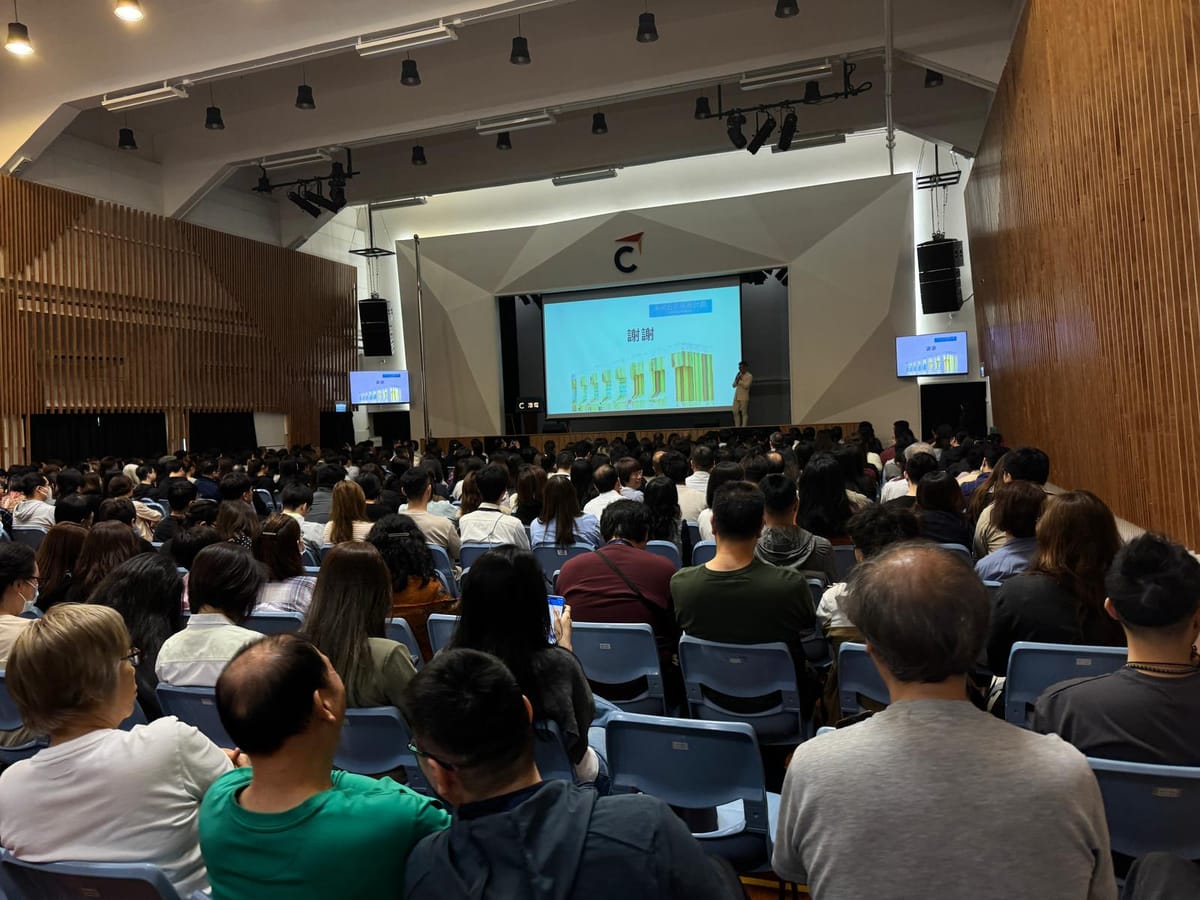
What the session covered
A three-part framework: AI Literacy (processing documents), AI Creativity (brainstorming and planning), and AI Visual/Document Creation (presentations and reports). Each part was demonstrated on deliberately mundane material -- actual meeting notes, actual administrative memos, the kind of documents that consume hours of an educator's week. The examples had to be boring to be believable. If someone watches you summarize a research paper in ten seconds, they're impressed. If they watch you summarize their department's meeting minutes, they start thinking about tomorrow morning.
The tools -- ChatGPT for text work, Canva for visual output, Perplexity for research -- were chosen because they're free to start and require no institutional approval. That last point matters in education. Teachers can try these tools tonight without submitting a procurement request or waiting for IT.
What worked
The time constraint. Seventy-five minutes forces you to cut everything that isn't essential. One framework, three parts, a few demonstrations, and a clear message: try one thing this week. People remembered the framework because there wasn't much to remember.
The ethics conversation. We spent real time on data privacy (what's safe to share with AI tools and what isn't), academic integrity (where the lines sit between AI-assisted and AI-generated work), and factual accuracy (AI outputs can be confidently wrong, and in teaching materials that creates real risk). I introduced the Traffic Light Protocol for categorizing sensitivity. Addressing the concerns directly -- rather than treating them as obstacles to enthusiasm -- built more trust than any demo did. The skeptics in the room became more engaged after the ethics section, not less.
What didn't work, or didn't work enough
Not everyone started experimenting. Not immediately, not within a week. The percentage who actually tried the tools afterward was higher than what I typically see after large-group sessions, but "higher than typical" still means a minority of four hundred people changed their behavior.
A 75-minute all-staff session can shift perception. It can give people a mental model simple enough to remember. It can lower the psychological barrier to trying something new. What it can't do is build habits. Habit formation requires hands-on practice with real material, repeated over time, with support when things break. One session doesn't provide any of that.
I knew this going in, and I should have been clearer about it -- both in how the session was framed and in how I wrote about it afterward. Promising a mindset shift to four hundred people is borderline overclaiming when most of them will walk away and keep working exactly as they were.
HKCT apparently reached the same conclusion, because they later committed to a 24-month AI Learning Community. That commitment -- not the 75-minute session -- is where the actual adoption story begins. The session was the permission slip. The two-year program is the work.
What surprised me
The strongest feedback came from the skeptics -- people who'd written off AI as overhyped or irrelevant to their work. Several mentioned the session changed their understanding of what the tools were for. Not that AI was amazing. That it was ordinary -- a way to do routine tasks faster, not a revolution they needed to either join or resist. For an audience of educators, "this saves you thirty minutes on meeting notes" turned out to be a more honest and more persuasive pitch than anything about transformation.
I teach AI to organizations for a living, and I regularly have to calibrate what a single session can promise. Seventy-five minutes with four hundred people is awareness, not adoption. That's a real deliverable -- it's just not the one most organizations mean when they say "AI training."
If you're planning AI introduction for an educational institution and want to discuss approaches, connect with me on LinkedIn.
