The brief was clear: make it practical, make it fast, and make it stick. Arup — the global engineering consultancy behind landmarks like the Sydney Opera House and the Bird's Nest Stadium — had invited me to run an AI session for their Hong Kong team in an unconventional format: a lunch break, a room full of engineers, and a challenge to rethink how they approach their daily work.
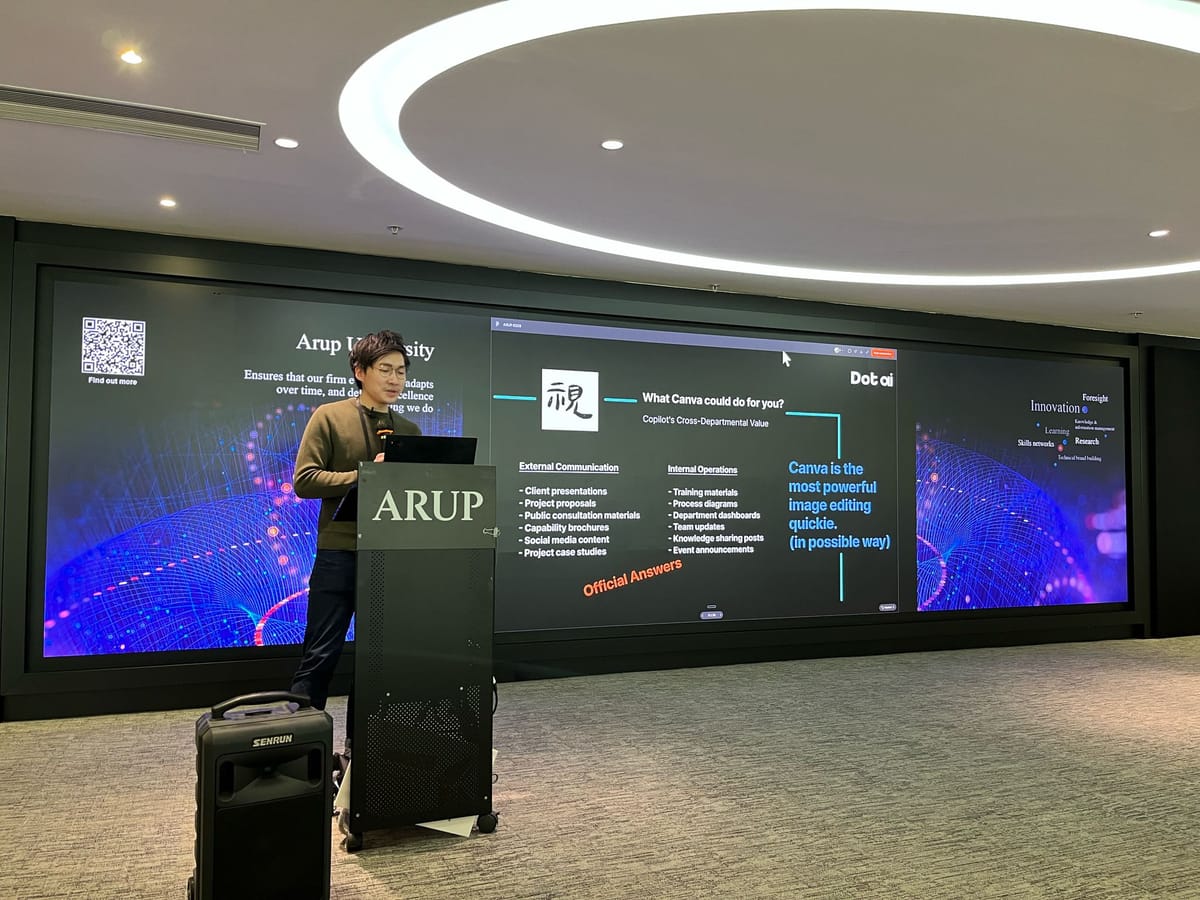
What emerged was a framework I now call "C-How Thinking".
The Problem With Tool-Centric Training
Most AI training sessions follow a predictable pattern: open ChatGPT, demonstrate some prompts, show off some outputs, end with Q&A. The audience leaves impressed but unchanged. Two weeks later, they're back to their old workflows.
Arup's challenge was different. As a multidisciplinary engineering firm, their teams juggle complex project documentation, cross-departmental communication, and client presentations that require both technical precision and visual clarity. The time cost of producing high-quality deliverables was becoming a competitive disadvantage.
They didn't need another tool demo. They needed a thinking shift.
The "C-How" Framework: Left Brain Meets Right Brain
The core insight came from observing how engineers naturally work. They're excellent at logical, structured thinking - the "how" of problem-solving. But when it comes to visual communication or creative presentation, many hit a wall. Not because they lack ideas, but because the execution overhead is too high.
"C-How Thinking" bridges this gap by integrating two AI workflows:
Left Brain (Copilot for Strategic Thinking)
We started with Microsoft Copilot, focusing not on features but on structured prompt design. Using Arup's actual work - a video script for an engineering project - participants learned to craft prompts that generate first drafts aligned with their brand voice. The key wasn't the output quality on the first try. It was understanding the iteration loop: prompt, review, refine, repeat.
Right Brain (Canva for Visual Execution)
The second half shifted to Canva's AI capabilities. Taking the text we'd just generated, participants transformed it into presentation-ready visuals in under ten minutes. Background removal, AI-generated imagery, automated layout suggestions - tools that would have required a design team or hours of PowerPoint wrestling.
The revelation for most participants wasn't either tool individually. It was the combination: AI handling both the logical structuring AND the visual execution, freeing them to focus on judgment and strategy.
Three Lessons From 45 Minutes
Lesson 1: Workflows Beat Features
I deliberately avoided showing every tool capability. Instead, we focused on one complete workflow: brief to draft to visual. Participants left with something they could replicate tomorrow morning, not a mental catalogue of features they'd forget by next week.
Lesson 2: Safety Comes Before Experimentation
Before touching any tool, we spent ten minutes on data governance. What can you input? What should you never input? For engineers handling sensitive project data, this wasn't a compliance checkbox - it was the permission they needed to actually use these tools without anxiety.
I introduced a simple "traffic light" mental model: green data (public, general knowledge), yellow data (internal, strip identifiers), red data (client confidential, full stop). The framework is intentionally simple because complexity kills adoption.
Lesson 3: Lunch Breaks Are Underrated
The "Lunch and Learn" format seemed limiting at first. Forty-five minutes isn't enough time for deep skill-building. But it's perfect for mindset shifts. Participants weren't exhausted from a full-day workshop. They were energized, curious, and - crucially - they had the rest of their workday to immediately test what they'd learned.
What I Didn't Expect
The most enthusiastic feedback came from non-obvious places. Marketing and HR teams saw applications I hadn't emphasized. Project managers recognized how this could streamline their client communication workflows. Engineers started discussing how to build internal knowledge-sharing systems using these same principles.
The cross-pollination was organic and unexpected. By framing AI as a thinking partner rather than a specialized tool, we'd opened a conversation that extended far beyond the session itself.
The Takeaway
Training engineers on AI isn't about showing them impressive demos. It's about reducing the cognitive overhead between their expertise and its expression. When a brilliant technical insight can flow from thought to draft to presentation in minutes rather than hours, something fundamental changes in how teams approach their work.
The technology keeps moving. The format held up, though: one complete workflow, ten minutes on data safety, and the rest of the workday to test it. If you're planning a session for a technical team, start there.
