I've trained over 10,000 professionals on AI adoption. The uncomfortable truth is that most of the AI training happening in companies right now will produce zero lasting behavior change.
Not because the content is bad. Not because the tools are wrong. Because the format is fundamentally broken.
A company books a half-day workshop. An external trainer shows up, demos ChatGPT, walks through some prompts, gets a 9/10 satisfaction score. Everyone goes back to their desks. Two weeks later, nothing has changed. The prompts are forgotten. The tools are unused. The company checks "AI training" off its list and wonders why adoption isn't happening.
I know this because I've been that trainer. And after training 10,000+ professionals across banking, retail, education, engineering, and tourism, I've learned that the workshop itself is the least important part of making AI training stick.
The forgetting problem
An employee learns fifteen prompts, three frameworks and two tools in a single session. By Friday they remember two prompts and no frameworks. By the following Monday it is as if the training never happened. That is not a failure of the content. It is what a one-off format does to anything.
When I ran five sessions for 1,530 banking professionals at a major Hong Kong bank, the program scored 9.2/10. But I knew from experience that satisfaction scores don't predict adoption. What predicted adoption was whether participants used at least one AI tool in their actual work within the first 48 hours. That became the real metric.
Where it fails
Across 70+ organizations the same things kill AI training. All of them are fixable.
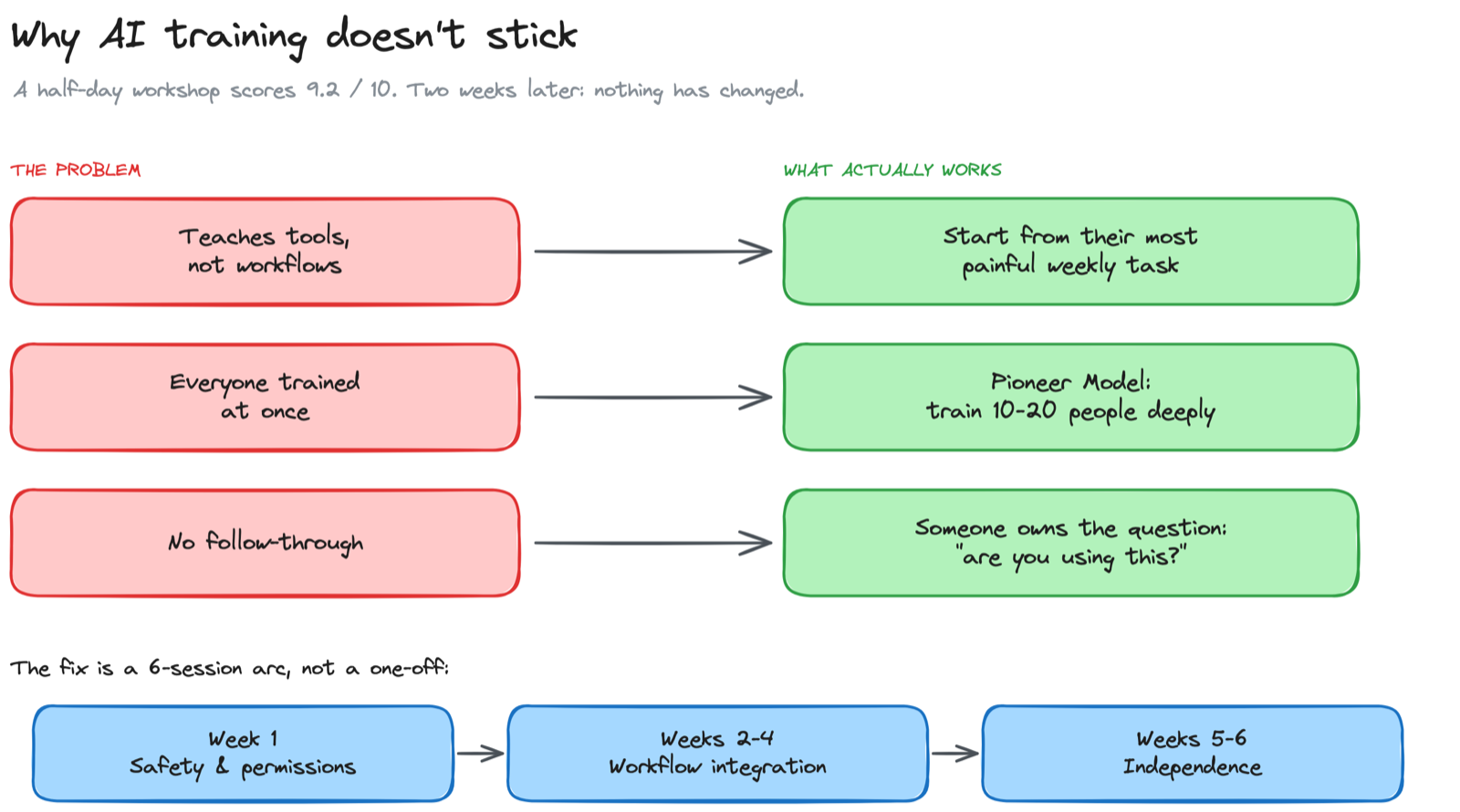
1. Training teaches tools instead of workflows
Most AI training looks like this: "Here's ChatGPT. Here's how to write a prompt. Here are ten things you can do with it." The trainer shows impressive demos. The audience is entertained. Nobody's actual work changes.
The fix is workflow-first training. Instead of "here's what ChatGPT can do," start with "show me your most painful weekly task." Then build the AI solution around that specific pain point.
When I designed a 4-module workshop for DoRich, participants brought their own repetitive tasks. One person automated a weekly data consolidation that took three hours. Another rebuilt her meeting prep workflow. The AI skills stuck because they were attached to real work from day one.
2. Everyone gets trained at once
The default corporate approach: book a conference room, invite everyone, run the same session for 50-200 people. It feels efficient. It's actually wasteful.
Large groups can't practice. They can't ask specific questions about their role. They can't bring messy, real-world problems because there's no time to work through them. The session becomes a demo, and demos don't build habits.
The approach that actually works is what I call the Pioneer Model. Instead of training everyone, you select 10-20 curious, influential people and train them deeply over multiple sessions. These Pioneers become internal champions who pull the rest of the organization forward.
When I ran a 6-session Pioneer Program for the food manufacturer's HR team, the 19 participants started teaching their colleagues without being asked, and the company had booked the next department before the first cohort finished. The training multiplied itself because the Pioneers had enough depth to help others.
3. There's no follow-through system
A workshop ends. The trainer leaves. Now what?
Most companies have no answer to this question. There's no follow-up session. No accountability structure. No one checking whether employees actually adopted what they learned. The training sits in a vacuum.
The organizations where I've seen the highest adoption rates all have one thing in common: someone owns the follow-through. At a major Hong Kong bank, I built reusable reference modules -- the Traffic Light Protocol, the IPA framework -- that teams could access weeks after the training ended. At the food manufacturer, the 6-session structure meant every week had a checkpoint: "What did you try? What worked? What didn't?"
Follow-through doesn't require expensive systems. It requires someone asking "are you using this?" on a regular basis.
The One-Off Workshop Isn't Dead. But It's Not Enough.
I still run single-session workshops. They serve a purpose -- awareness, demystification, getting skeptics to lower their guard. When I introduced the AI Three-Part Framework to 400 educators at HKCT, the shift from skepticism to experimentation happened in 75 minutes. That's real value.
But awareness is Stage 1 of the AI maturity model. It's not adoption. Moving from "I understand what AI can do" to "I use AI every day in my actual work" requires a different structure entirely.
Here's what that structure looks like:
Week 1: Safety and permissions. Establish what's allowed. Define the data sensitivity tiers. Remove fear before adding capability.
Weeks 2-4: Workflow integration. Each session focuses on a specific work task -- not an AI feature. Participants bring real problems. They leave with working solutions they'll use the next morning.
Weeks 5-6: Independence. Participants design their own AI workflows. They teach someone else on their team. The test isn't "can you use the tool?" It's "can you figure out how to apply it to a problem you haven't seen before?"
This is essentially the Pioneer Program structure. It works because it's built around change management principles, not training principles. The difference matters.
Why This Problem Is Getting Worse
The AI training market is growing fast. More trainers, more courses, more vendors. But most of what's being sold is the exact format that doesn't work: one-off sessions that prioritize tool demos over behavior change.
Companies buy these programs because they feel productive. An L&D manager gets to report "we trained 200 employees on AI." The vendor gets a testimonial. Everyone moves on. Six months later, the same company is still at Stage 1 maturity, wondering why their "AI-trained" workforce isn't actually using AI.
The 70/14 gap -- 70% of managers wanting AI training but only 14% of workers receiving it -- isn't just about supply. It's about the quality of what's being supplied. A bad training experience can actually set adoption back by reinforcing the narrative that "we tried AI training and it didn't work."
What I'd Tell a Company Spending Its First Dollar on AI Training
If you have budget for one thing, don't buy a workshop. Buy a 6-session program for 15 people.
Select participants who are curious, influential, and willing to experiment. Give them real tasks every week. Measure time saved on actual workflows, not satisfaction scores. Let them become the internal champions who pull everyone else forward.
If budget is truly limited, at minimum do this: run the workshop, then schedule three 30-minute follow-up sessions over the next six weeks. Just three touchpoints. Ask "what did you try?" and "what's blocking you?" In every engagement where nobody asked those questions, the answer six months later was that the training had happened and nothing else had.
The companies that win the AI adoption race won't be the ones that trained the most people. They'll be the ones whose training actually changed how people work.
